When we think about serotonin, we often picture the brain but in reality, most of the serotonin in your body is made in your gut! Specialized cells in the gut lining work with trillions of microbes to produce and regulate this “feel-good” chemical. That’s why diet has such a powerful effect on mood and focus. A diet that is fiber-rich, contains a balanced mix of proteins, healthy fats, and nutrient-dense plants supports a diverse microbiome. This in turn helps maintain a consistent supply of serotonin. Although we may not think it, every meal is an opportunity to nourish both your body and mind. At Metabolic Balance we create personalized nutrition plans for all of our clients to ensure that they have a balanced diet that support optimal health and wellness! To learn more visit our website!
Let’s talk gut health! Did you know your gut plays a huge role in how your body processes nutrients, manages weight, and even affects your mood? To keep your gut happy, focus on a diverse diet rich in fiber, fruits, vegetables, and whole grains. To nourish good bacteria, incorporate probiotics from foods like yoghurt and prebiotics like bananas. Stay hydrated, reduce processed foods, and manage stress with relaxation techniques. It’s all about balance. In the Metabolic Balance program, we focus on supporting your unique digestive system with personalized nutrition. When your gut is happy, your metabolism works better, too. So, let’s give your gut the care it deserves for a healthier, more balanced you!
Inflammatory bowel disease – Crohn’s disease and ulcerative colitis
The incidence of inflammatory bowel disease (IBD) is increasing worldwide. Worldwide, about ten million people suffer from IBD. Two of the most common types of IBDs are: Crohn’s disease and ulcerative colitis. They usually manifest in adolescence or early adulthood. Neither disease is curable, there may be mixed forms of both diseases, and patients can suffer from relapses in both diseases.
Crohn’s disease can affect all sections of the digestive tract – from the mouth to the anus. The most common site of inflammation in Crohn’s disease is the last section of the small intestine and the beginning of the adjacent large intestine. The inflammation extends through all layers of the intestine.
The involvement of the small intestine in Crohn’s disease can lead to inadequate absorption of nutrients. Vitamin B12 deficiency is particularly common.
In contrast, ulcerative colitis exclusively affects the large intestine and is found only on the uppermost layer of the intestinal mucosa. During an inflammatory episode, the colon can only reabsorb water to a limited extent and this leads to diarrhea, among other symptoms.
Symptoms of IBD
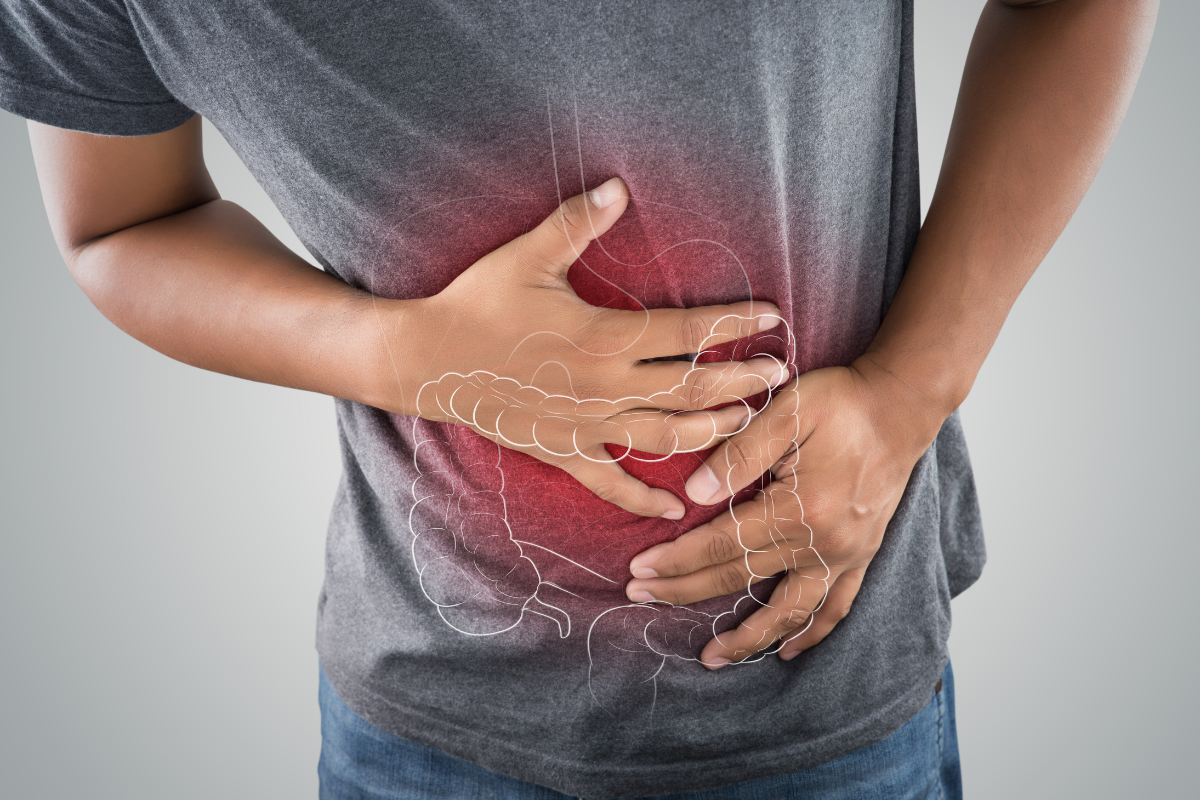
Patients complain mainly of pain in the right lower abdomen and occurrence of bloody and non-bloody diarrhea, often accompanied by cramps. Anal fistulas and abscesses are common.
In addition, other organs may be affected, such as joints, eye, liver or skin.
An additional accompanying symptom is also the impaired absorption of nutrients through the intestine, since the intestine is damaged. In the long run, this leads to further health problems, such as skin changes, growth disorders in children, anemia, gallstones, and even unwanted weight loss.
How do inflammatory bowel diseases develop?
It is now assumed that several factors contribute to the outbreak of both diseases. These include a hereditary component, environmental influences, frequent medication, the intestinal microbiome and a disturbed barrier function of the intestinal mucosa and the associated overreaction of the immune system.
The influence of nutrition is also discussed in IBD, moreover in older studies there is evidence that refined sugars, low fiber and unfavorable fatty acids help to ignite inflammation in the gut.
Current studies also address the question of whether sulfur-containing foods or sulfur-containing additives may be partly responsible for the inflammatory changes in the gut.
Nutrition in IBD
There is currently no specific diet or proven beneficial diet for IBD. Nevertheless, a healthy diet should be included as the basis for any applied therapy in IBD in order to also avoid an undersupply of micro- and macronutrients. Good nutrition certainly cannot completely prevent a flare, but it has been shown to have a positive effect on the course of the disease.
During the acute phase – what to eat?
In this phase it is particularly important to provide the body with sufficient energy, nutrients and fluids and yet not overload the intestines. This is not always easy! The easiest way is to reduce fiber over time, avoid fried, fatty foods and, above all, eat foods that are easy to digest. Creamy pureed soups, steamed vegetables, avocado, steamed fish and natural yogurt are just a few foods that can be quite helpful during this phase and also provide the necessary nutrients and energy.
During this phase, the patients mainly lack protein because the immune system works at full speed and consumes a lot of protein to produce antibodies. In this phase, the metabolism has a protein requirement of 1.2 to 1.5 grams ~2 lbs of body weight.
Free of complaints – balanced nutrition
There is currently no general dietary recommendation for symptom-free periods. However, studies show that avoiding foods that are too sour, too spicy, too sweet and too fatty is good for the intestines. A balanced, healthy diet, containing mainly fresh foods such as vegetables, fruits and herbs, has a positive effect on IBD. This is because these foods contain an abundance of antioxidants and anti-inflammatory nutrients. In order to also allow the intestines sufficient recovery time, it is better to avoid raw vegetable foods at the beginning and to prepare the vegetables gently so that as many valuable vitamins as possible are retained. Furthermore, omega-3 fatty acids support cell structure and cell regeneration. Therefore, sea fish and cold-pressed cooking oils, such as linseed, rapeseed, hemp or walnut oil should be frequently integrated into the diet.
A nutrition based on unprocessed foods also provides important minerals, such as magnesium (oatmeal, nuts, green vegetables, legumes) and zinc (fish, dairy products, nuts, legumes, meat, whole grains), which are extremely important for the metabolism. Both minerals are involved in over 300 metabolic processes. It has even been proven that actually a slight zinc deficiency can trigger an outbreak of inflammation. But the B vitamins must also be supplied in sufficient quantities to avoid deficiencies. B vitamins are water-soluble and are excreted in diarrhea to an increasing degree.
Metabolic Balance and IBD
As I said, there is no such thing as “the diet” for inflammatory bowel disease, but there is a recommendation for a balanced, healthy nutrition. Metabolic Balance is an anti-inflammatory diet and can help sufferers to eat healthily in both acute and symptom-free phases. With the individual composition of foods, the Metabolic Balance nutrition plan provides a guideline for more well-being and vitality.
Gut health is closely tied to a healthy diet and lifestyle. There are a few simple steps you can take to help keep your gut happy and healthy:
-5+2 – aim for 5 different veggies and 2 fruits every day
– Make sure to eat a lot of fiber (up to 30g per day). At Metabolic Balance we recommend a variety of veggies, nuts, seeds, rye bread and a daily apple
-Try avoiding processed foods. Choose real foods that don’t need an ingredients list
Research shows that a diet with wholegrains and minimal processed food lowers the risk of colorectal cancer and can benefit the beneficial microbes in the gut. The Metabolic Balance® program is a wholefood personalized meal plan that has helped thousands of clients get results. Get in touch to find a coach near you!
Although many people still avoid talking about their digestion and stool, it is essential to look at the color, size, shape, and frequency of your stool as it is an indicator of your overall health. Is it important to check that because many people have no idea what a “normal” bowel movement is supposed to be like. Your digestive system and gut microbiome is involved in all facets of health. Dysbiosis or an imbalance in the microbes in your gut can impact your mood, immune system, and overall wellness. When your digestive system and microbes are are not functioning optimally, it can be essential to understand the underlying causes that contribute to the problem. But what would a “normal” stool be? Our answer is that it should be like a soft sausage; smooth and soft, easy to pass with no straining and a mid-brown color. Believe it or not, there is a ‘stool chart’ called the Bristol Stool Chart, which provides a visual guide to the different types of stool. Ideally, yours should be something like 3, 4 or 5. We provide the image in this post. Be aware of this part of your health too and help to prevent future problems.








 Metabolic Balance Blog
You must be logged in to post a comment.